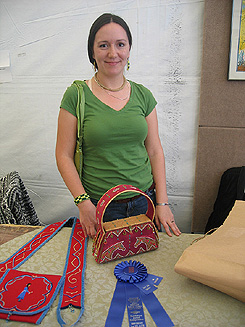
We are extremely pleased to
present the award-winning work of Lakota artist, Molly Murphy.
This box incorporates Plains Indian imagery and symbolism combined
with contemporary abstract designs. Please take a moment to learn
more about Molly, and read her personal statement.
Molly Murphy was born in 1977
in Great Falls, MT. A mixed blood descendent of the Oglala, Lakota
tribe, Murphy was raised in western Montana and earned a Bachelor's
in Fine Arts from The University of Montana in 2004.
Most of her work stems from
a combination of traditional Native arts and modern art. Murphy
learned beadwork at a very early age as well as hide tanning,
sewing and traditional clothing design. I consider my work to
be narrative on many levels.
There are times when I want
to tell a very specific story and the pieces become narrative
in tone. In other cases I am simply evoking emotional responses
to basic elements such as shape and color.
Nearly all of my work reflects
the issues of politics, cultural identity, and learning to live
with the weight of the past. Molly Murphy currently lives in
Missoula, Montana with her husband and daughter.
Along with being a resident
artist and guest lecturer throughout Montana, Molly's recent
awards and exhibitions include:
2007 Heard Museum Guild Fair
and Market, Phoenix, AZ, 1st Place Class VII Division A, 2nd
Place Class VII Division B, Judges Choice, Cirillo , Judges Choice,
Dittemore
2006 Heard Museum Guild Fair
and Market, Phoenix, AZ, 2nd Place Class VII Division B, 2nd
Place Class VII Division C
Wheelwright Museum, Sante Fe, NM, Holiday Exhibit and Auction
Art Without Reservations:
Changing Hands 2, Museum of Arts and Design, New York, NY
Artist Statement:
The inspiration for my beaded
box series comes from traditional art forms such as parfleche
containers, pottery, baskets, and hide painting. The patterns
on historical objects speak to me and I continue to be compelled
to use the parts and pieces of patterns in new ways. For me beadwork
is the perfect synthesis of old and new. With beads I can tell
stories, show shapes and talk about my landscape while never
feeling I have lost touch with traditional forms. The boxes use
materials that anyone could go and buy, it is only my interpretation
that makes it different than mainstream art.
This particular box is a depiction
of horses coming together from four corners. Each horse head
has a slightly different pattern on the interior shape. The lid
has bilaterally symmetrical designs on both the interior and
exterior with the lid being reversible. The lid really doesn't
have a right or wrong direction to be placed on the box. There
are 16 distinct patterns and 48 possible ways the lid can be
placed on the box. I intended this piece to be a play on numbers,
possibilities, and the overreaching importance of the number
four and how it relates to Native beliefs concerning place and
centeredness.
The care and handling of beadwork
differs from other media. The wool components can be gently dusted
with a lint free cloth, or an adhesive lint remover used to remove
particles. Also you may use canned forced air used to clean electronics.
Keep out of direct sun and avoid high humidity. Beadwork has
characteristics of both strength and delicacy. Gently dusting
and proper care when moving should ensure that beadwork retains
its original appearance.
Detailed list of media and components
for conservation purposes: commercial woven wool, Pellon brand
interfacing, Nymo brand nylon thread, balsa plywood, Czech glass
beads size 13,14, and 15, adhesive, metal findings.