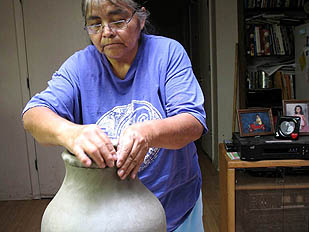
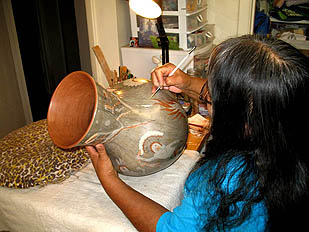
The way that Lucy makes pottery is a
long, tedious, and time-consuming process. Emphasis is on quality
rather than quantity. The following is a very abbreviated version
of how it is done.
Clay Preparation
The clay is usually mined under big
overhanging sandstone cliffs usually near the tops of the mesas
in many places throughout the Southwest. It us brought home and
soaked in buckets of water for over a month and is screened through
many mashes of screen with the final mash being as fine as cloth.
Ground mica temper is mixed with it. After the final screening
the soupy mixture of clay is poured on drying racks covered with
sheets and allowed to dry to the right consistency to make pottery.
Then it is stored in big plastic trash cans until it is made
into pottery.
When they are ready to make pottery
they beat and kneed the clay to remove air bubbles and to mix
the white and red clays together in a secret way to make the
marbleized pottery.
The Making of the Pots
The pots are usually started in the
bottoms of open bowls and coiled up from there one coil at a
time. The coils are put together by sliding and pinching the
coils to the ones below and thinning them by pinching them between
her fingers and scraping with gourd scrapers. Usually 4-7 pots
at a time are worked on so that a coil or two can be added at
a time and allowed to firm up while she is working on other pots.
This drying between coils prevents the pots from collapsing when
being worked on. Lucy is known for her unusually large size pots
of many unique, and varied shapes, and for making handles and
overlay on pots.
Smoothing, Slipping, Polishing, and
Painting of the Pots.
When the pots are dried they are sanded
with a series of sandpapers until they are finally sanded to
a 320 grit. Next they are evened out so the top and bottom will
be almost perfectly even. The pot is then measured out and the
basic background is drawn on with a pencil. The background is
slipped with water and stone polished and then the various other
clay slips are applied three times and stone polished one color
at a time. Finally the black paint is made by grinding the hematite
paint mixed with the juice of bee plant on a sandstone pallet.
This grinding takes about one and a half hours of hard work to
grind a days worth of paint. Then the black paint is then painted
on the pot.
Firing the Pots
The pots are fired outside in a fire
of Sheep manure and cedar wood. They are protected from the fire
by pot shards and burned off tin. Firing temperatures reach between
1800-1900 degrees F. Most of her pottery has a few firing blushes
where the fire got extra hot. Pots fired outside usually have
better and varied coloring and are shinier. However, firing in
this manner is sometimes disheartening as the pots can break
when a sudden gust of wind or rain comes up or if the fire heats
unevenly. Also the pottery can under-fire if the manure is damp
or has too much sand in it.
Final Statement
As you can see the making of their pots
is a very long process. Lucy is basically self taught but received
a little help from Hopi-Tewa friends. It has taken her 30 years
to learn to make her beautiful pottery and is glad that all of
her daughters are fine potters in their own right and that one
of them is taking it up as a career even though she has a college
degree. She has been trying to make Navajo pottery evolve up
into a fine art going up and above tradition while still using
native techniques and home refined materials that are all natural.
Most of the designs are adapted from Navajo sand painting designs,
rug and basket designs, and the ancient pottery designs from
the ancient ruins that are so numerous in the area the she grew
up in.
More About the Artist:
Education: -Brigham Young University
Provo, Utah
B.S. In Elementary Education and Indian Studies
Tribe: Navajo with some Hopi-Tewa ancestry
Clan: Tlashchi’i (Red Bottom) born
for Todichi’ni (Bitter Water)
Work Experience: - 9 years teaching
on the Navajo Reservation at various places, kindergarten, grades
2nd, 3rd, and junior high school art.
-Various artists in residence at elementary
schools in the Four Corners area
-19 years as a professional full time
potter
Shows & Exhibitions and Collections:
Santa Fe Indian Market (29 years)
Heard Museum
Eight Northern Pueblos
Gallup Ceremonial
Denver Museum of Natural History Collection
Dallas Indian Festival of Arts
Totah Festival
Eitljorg Museum Show
San Diego Museum of Man Collection
Southwest Museum, Los Angeles
Red Earth Festival, Oklahoma City
Indian Artists of America, Scottsdale
Pueblo Grande Show, Phoenix
Raymond James Financial Institution
Smithsonian Collection
Heard Museum Collection
Albuquerque LDS Temple
Lane Allen Collection Smithsonian Collection
Featured Publications: Pueblo and Navajo
Contemporary Pottery by Guy Berger & Nancy Schiffer 2000,2004
Treasures of the Navajo by Theda Bassman
1997
Native Peoples 1992 (cover and article)
Enduring Traditions by Jerry &Lois
Jacka 1994
“Indian Trader” Oct. 1992
“Gallup Independent” Sept.
13, 1992
“Arizona Highways” Nov. 1988
Indian Market supplement to the Albuquerque
Journal. August, 2002
Beyond Tradition by Jerry &
Lois Jacka 1988
Navajo Pottery by Russell Hartman &
Jan Mesial 1987
Honors, Awards, & Accomplishments:
- 35 years making pottery, 19 years
full time.
- Numerous awards at Santa Fe Indian
Market, Gallup Ceremonial, Heard Museum (Maria Martinez Memorial
Award), Totah Festival, Dallas Indian Market, Southwest Museum
in Los Angeles, Navajo Tribal Fair, New Mexico State Fair, Best
of Show Totah Festival, Farmington, NM
Influences: The ceremonies and traditional
teachings of my grandfather and of my great-grandmother who partially
raised me. Also the pottery from the ancient ruins near my home
and my many Pueblo friends who inspired me, and quite possibly
some of my Hopi-Tewa ancestry.
Artist Statement: I am mostly a self-taught
potter who has spent 35 years refining the art of Navajo pottery
up and beyond tradition but still using traditional materials
and methods.